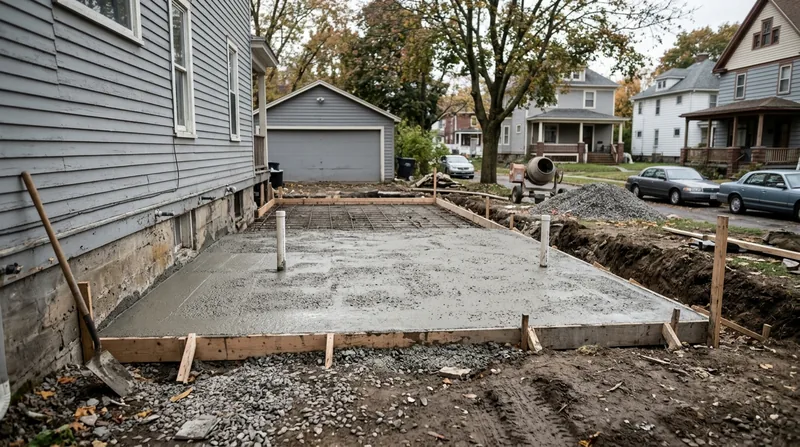




Concrete slabs and foundations in Syracuse are the backbone of any new structure, from garage additions to garden sheds and room expansions. Here in Central New York, where glacial till and silty clay underpin our neighborhoods, a solid foundation and properly engineered slab make the difference between a structure that lasts 50 years and one that settles, cracks, or heaves within a decade. Syracuse's deep frost line, well over four feet, combined with more than 100 inches of lake-effect snow and dozens of freeze-thaw cycles each year, means your concrete must be built to withstand extreme seasonal stress. We pour slabs and footings with air-entrained mixes, compacted base drainage, and steel reinforcement engineered for the loads and climate you'll face. Whether you're building on a narrow Strathmore lot, a ranch foundation in Camillus, or a new colonial in Manlius, we start with the ground itself.
Why Proper Slabs and Foundations Matter in Syracuse's Freeze-Thaw Climate
Concrete in Syracuse fails for one reason above all others: freeze-thaw heave. Water enters small air pockets in poorly designed concrete, freezes, expands, and cracks the slab from within. This happens dozens of times each winter. A slab poured without air entrainment, without proper slope for drainage, or on an inadequate base will begin to scale, spall, and settle within three to five years. Your foundation must be engineered for depth, reinforcement, and drainage from day one, because Syracuse's winters don't forgive shortcuts.
- We specify air-entrained concrete mixes that trap microscopic bubbles to absorb ice expansion without cracking.
- We install compacted gravel or stone base layers to manage subsurface water and prevent frost heave under footings.
- We reinforce slabs with steel rebar or wire mesh to distribute loads and resist the stress of seasonal movement.
- We slope every slab away from structures so meltwater and rain drain, not pool and refreeze.
- We pour to engineered thickness, typically 4 to 6 inches for residential slabs, based on load and frost depth.
A foundation built this way will hold steady through 50 winters and more.
Key info: The New York State Building Code requires footings to extend below the frost line (nearly 4 feet in Syracuse) to prevent heave. We design every foundation to meet or exceed that depth, plus we add drainage and air entrainment so your structure stays level and dry year after year, even in a Tipperary Hill winter.
For more on how freeze-thaw damage happens and how to prevent it, see our guide to concrete repair and resurfacing in Syracuse.
How We Build Concrete Slabs and Foundations: Our Process in Syracuse
Every slab and foundation we pour follows the same disciplined sequence: site assessment, base preparation, reinforcement layout, mix design, and finishing. We don't rush. We work with your architect or contractor to confirm depth, dimensions, and load requirements, then we build to those specs. In Syracuse's short pouring season (May through October), we schedule carefully so we can cure your concrete properly before the first hard freeze.
- We excavate and compact the subgrade to remove soft soil and ensure a stable bearing surface.
- We install a gravel or stone base, typically 4 to 6 inches, and compact it in layers to prevent settling.
- We set forms and reinforcement, placing rebar or wire mesh at the correct height and spacing for the load and frost depth.
- We order and pour air-entrained concrete mixed and delivered to our specifications, not generic ready-mix.
- We finish the surface to the slope and smoothness your project requires, then protect it for proper curing.
- We remove forms after 24 to 48 hours and allow full strength development before you load the structure.
This process takes longer than a rushed pour, but it's the only way to build something that will last in Syracuse.
Example: A homeowner in Liverpool wanted to add a two-car garage to a 1950s ranch. The existing house sat on a 3-foot footing. We excavated to 4.5 feet, installed a compacted stone base, poured a new foundation with air-entrained concrete and continuous rebar, and sloped the garage floor for drainage. Two years later, through two full freeze-thaw cycles, the foundation remains level and crack-free.
Learn more about how we prepare sites and manage drainage in our concrete leveling and slab lifting service page.
Concrete Slab and Foundation Methods: What We Use and When
| Method | Description | Best For |
|---|---|---|
| Slab-on-grade with air entrainment | Concrete poured directly on compacted base with entrained air bubbles and reinforcement mesh or rebar. | Garage floors, sheds, patios, and additions where frost heave risk is moderate to high. |
| Perimeter footing with stem wall | Footings dug below frost line with a concrete stem wall rising above grade to support framing. | New house foundations, room additions, and structures requiring full basement or crawlspace. |
| Thickened-edge slab with integrated footing | Slab with a thickened perimeter that serves as both slab and footing, poured monolithically. | Smaller additions, screened porches, and light-frame structures where cost efficiency matters. |
| Post and pier foundation | Concrete piers dug to frost depth with posts set on top, used where full slab is not practical. | Decks, sheds, and structures on steep or wet sites common in Skaneateles or Cazenovia terrain. |
Each method is chosen based on your site, soil conditions, frost depth, and what the structure will carry. We assess your specific lot before recommending an approach.
Concrete Slabs and Foundations Cost in Syracuse: What to Expect
Concrete slab and foundation costs in Syracuse typically start at around $5 per square foot for a straightforward slab-on-grade with air-entrained concrete and proper base preparation. That baseline assumes a level site, accessible for equipment, and no unusual soil conditions. However, several factors push that number up, and it's essential to understand them before you get a quote.
Depth of excavation is the biggest cost driver. If your site requires digging to the full 4-foot frost line (common in North Syracuse, Baldwinsville, and Manlius), or if you're working on a sloped lot in the drumlins north of the city, excavation time and base material volume increase. Soil conditions matter too: if we hit rock or soft clay that needs replacement, the cost rises. Site access affects pricing as well. A narrow driveway in Strathmore or Westcott may require smaller equipment and hand labor, adding time and cost. Reinforcement type (wire mesh vs. rebar) and concrete mix specification (air-entrained vs. standard) also influence the final price.
We always recommend getting two or three estimates from insured contractors in your area. This gives you a realistic range and helps you spot red flags (unusually low bids often mean corners will be cut on air entrainment or base prep). Visit our full pricing overview to see how different job sizes and site conditions affect cost.
The best way to lock in an accurate price is a free on-site estimate. Call us at (680) 207-3875 and we'll visit your property, assess the soil, check frost depth, and give you a firm number within 24 hours.
What to Look for When Hiring a Concrete Contractor Near Syracuse
Hiring the right contractor for your slab or foundation is not about finding the cheapest bid. It's about finding someone who understands Syracuse's climate, respects building codes, and will be there if something goes wrong. Here's what to ask and check before you sign.
First, confirm that your contractor carries general liability insurance and workers compensation coverage. Ask to see a current certificate of insurance naming your property. This protects you if someone is injured on the job or if equipment damages your home. Don't proceed without proof of coverage.
Second, ask for references from recent jobs in your area. Call at least two homeowners and ask about the quality of the finished work, whether the job stayed on schedule, and how the contractor handled any issues. A contractor who has done good work in Camillus or Solvay will tell you proudly.
Third, understand the permit requirements for your job. In Syracuse and surrounding towns, new foundations and slabs may require a building permit and inspection. Your contractor should know this and help you navigate it. Ask them to explain what permits apply to your project and why.
Fourth, if your property is in an HOA or historic district, ask your contractor whether they've worked with those restrictions before. Some neighborhoods in Strathmore or near Onondaga Lake have setback or architectural rules that affect how a foundation can be built.
Finally, get everything in writing: the scope of work, the price, the schedule, and what happens if weather delays the pour. A good contractor will be clear and honest about all of this.
Ready to get started? Contact us for a free estimate. We'll answer all your questions and give you a price you can trust.
Concrete Slabs & Foundations in Syracuse: Pricing Guide
| Service | Price | Details |
|---|---|---|
| Slab-on-grade (standard residential) | Starting at $5/sq ft | Air-entrained concrete, compacted gravel base, wire mesh reinforcement, finished surface sloped for drainage |
| Perimeter footing with stem wall | Starting at $12/linear ft | Excavation to frost depth, concrete footing and stem wall, rebar reinforcement, labor and materials for full height |
| Site with difficult access or steep slope | Starting at $6.50/sq ft | Added excavation time, hand labor, smaller equipment, extended base preparation on uneven or wet terrain |
| Large addition or new construction foundation | On estimate | Scope, soil testing, and site survey required before pricing; typically $8 to $15 per square foot depending on complexity |
| Travel and site visit | Included | No separate mileage charge within Syracuse and surrounding service areas including Liverpool, Baldwinsville, Manlius |
| Free estimate | Free | On-site assessment, written quote, and no obligation to book; response within 24 hours at (680) 207-3875 |
Indicative pricing, the exact cost depends on square footage, finish, and site access. Free personalized estimate within 24h at (680) 207-3875.


